
the fourth turning is here pdf
The Fourth Turning is Here: A Deep Dive into Strauss & Howe’s Prophecy
Strauss and Howe’s prophetic work, readily available as a Fourth Turning PDF on platforms like EALIB.COM, details cyclical history and America’s impending crisis.
Understanding the Core Concept of Turnings
Turnings, as defined by Strauss and Howe in their seminal work – often sought as a Fourth Turning PDF – are not merely periods, but distinct eras of mood, cultural focus, and societal development. These cycles, roughly 80-100 years in length, shape American history into a recurring pattern of four phases. Each turning builds upon the last, creating a dynamic interplay between generational character and collective experience.
The core concept revolves around the idea that history isn’t random, but rather unfolds in predictable rhythms. These rhythms aren’t deterministic, but they establish a framework for understanding societal shifts. A Fourth Turning PDF download reveals how each turning possesses a unique “vibe” – a dominant cultural ethos that influences everything from politics and economics to art and social norms. Understanding these turnings allows for a deeper comprehension of present challenges and potential future trajectories, offering a lens through which to view current events.
The Generational Theory Foundation
Strauss and Howe’s theory, central to understanding the Fourth Turning (and readily accessible via a Fourth Turning PDF), posits that generational character is forged by the turning in which individuals come of age. Each generation reacts to the preceding turning, developing distinct attitudes and values. These generational archetypes – Prophet, Nomad, Hero, and Artist – repeat throughout history, influencing societal dynamics.
The authors argue that these generational personas aren’t arbitrary; they are a direct response to the prevailing social and political climate. A Fourth Turning PDF illustrates how each archetype plays a specific role during each turning, contributing to the overall narrative of American history. This framework allows for a predictive understanding of how different generations will behave during times of crisis, offering insights into potential societal responses and leadership styles. The interplay between these generations is key to navigating the challenges ahead.
The Four Turnings: A Historical Overview
Strauss and Howe, as detailed in resources like a readily available Fourth Turning PDF, identify four recurring “turnings” in American history: High, Awakening, Unraveling, and Crisis. Each turning lasts roughly 20-25 years, forming a cyclical pattern spanning approximately 80-100 years – a “saeculum.”
The High is a period of strong institutions and social order. An Awakening is a cultural and spiritual rebellion against the High. The Unraveling sees institutions weakening and individualism rising. Finally, the Crisis is a period of upheaval, often involving war or significant societal disruption, forcing collective action. A Fourth Turning PDF showcases historical examples – the American Revolution, the Civil War, the Great Depression/WWII – illustrating how these turnings have manifested previously.
Understanding this historical context, as presented in their work, is crucial for interpreting the current moment and anticipating the challenges of the approaching Crisis.

Decoding the Current Turning
Contemporary America, according to Strauss and Howe’s analysis (accessible via a Fourth Turning PDF), is firmly within a Fourth Turning – a period of crisis and reckoning.
Why 2026 is Considered a Critical Year
The year 2026 emerges as pivotal within the framework of Strauss and Howe’s generational theory, detailed in resources like the readily available Fourth Turning PDF. This timing isn’t arbitrary; it represents the projected apex of the current Crisis era, aligning with an approximately 80-100 year cycle identified by the authors.
Their research suggests that following a period of Unraveling – characterized by weakened institutions and growing social fragmentation – a Crisis looms, culminating around 2025-2026. This isn’t a prediction of a specific event, but rather a forecast of intensified societal pressures and potential upheaval. The Fourth Turning PDF emphasizes that these cycles aren’t deterministic, but represent recurring patterns in American history.
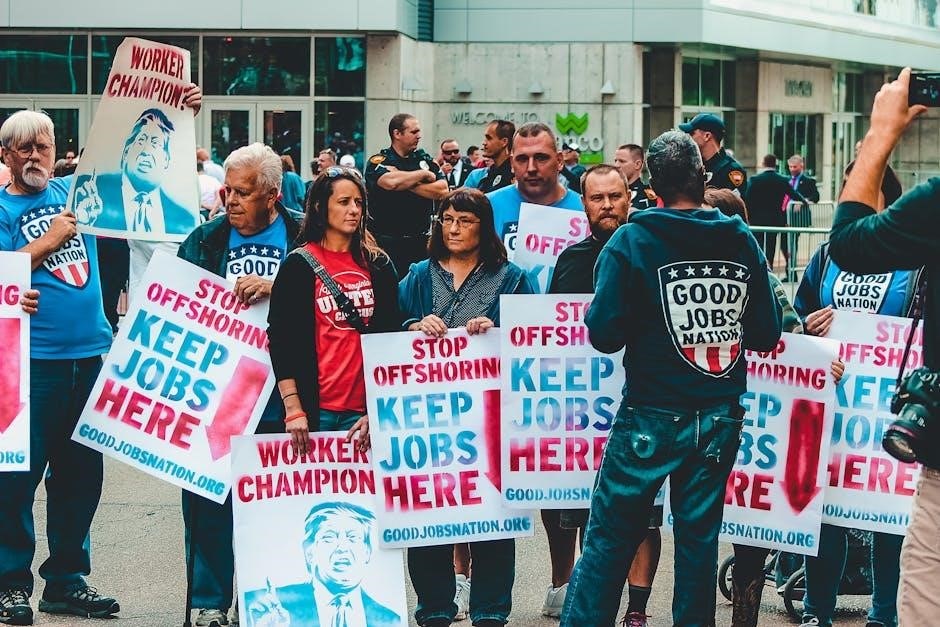
The convergence of various factors – political polarization, economic instability, and cultural shifts – contribute to this sense of impending crisis. Understanding this cyclical framework, as presented in the Fourth Turning, allows for a more informed perspective on current events and potential future trajectories.
Signs of a Fourth Turning in Contemporary America
Contemporary America exhibits several hallmarks consistent with the Fourth Turning as outlined in Strauss and Howe’s work, accessible as a Fourth Turning PDF. A pervasive sense of unraveling is evident – declining faith in institutions, increased political polarization, and a growing feeling of societal fragmentation. These aren’t isolated incidents, but interconnected symptoms of a larger pattern.
The rise of populism, both on the left and right, reflects a rejection of established norms and a yearning for radical change. Economic anxieties, coupled with widening wealth inequality, further fuel this discontent. Moreover, a noticeable increase in social unrest and cultural clashes points towards a breakdown of collective consensus.
The Fourth Turning PDF suggests these signs aren’t anomalies, but predictable phases within a recurring historical cycle. While not guaranteeing a specific outcome, recognizing these patterns allows for a more nuanced understanding of the challenges facing American society today.
The Role of Crisis in Societal Transformation
According to Strauss and Howe’s Fourth Turning theory, detailed in the readily available Fourth Turning PDF, crisis isn’t merely a destructive force, but a catalyst for fundamental societal transformation. These periods of upheaval dismantle old orders, clearing the way for the emergence of new ones.
The authors posit that previous “Crises” – the American Revolution, the Civil War, the Great Depression/World War II – each resulted in a dramatic reshaping of American institutions, values, and national identity. These weren’t simply periods of suffering, but opportunities for collective rebirth.
The Fourth Turning PDF emphasizes that such crises demand collective action and sacrifice. Existing structures prove inadequate, forcing a re-evaluation of priorities and a willingness to embrace bold solutions. While painful, these moments forge a stronger, more unified society, prepared for the challenges ahead. The current era, they argue, is no different.

Generational Roles in the Fourth Turning
Strauss and Howe’s Fourth Turning PDF outlines distinct generational roles during crisis: Prophets, Nomads, Heroes, and Artists, each with unique contributions.
The Prophet Generation (Boomers)
According to Strauss and Howe’s cyclical theory, detailed within the accessible Fourth Turning PDF, the Boomer generation – the Prophets – enter their elderhood during a Crisis. Having come of age during a high point of societal optimism and expansion, they now find themselves tasked with offering moral guidance and attempting to resolve the unfolding turmoil.
However, their past successes and established authority often lead to resistance from younger generations who perceive them as out of touch or clinging to outdated ideologies. The PDF suggests Boomers may struggle to relinquish control, potentially exacerbating conflict. Their role isn’t necessarily to lead the solution, but to provide a framework of values and a sense of collective memory, even as their influence wanes. They are the generation that remembers a better time, and their warnings, though sometimes unwelcome, carry weight. The challenge lies in their ability to adapt and acknowledge the need for change, rather than attempting to restore a past that is irrevocably gone.
The Nomad Generation (Gen X)
As outlined in the Fourth Turning PDF by Strauss and Howe, Generation X – the Nomads – are uniquely positioned during a Crisis. Having grown up amidst institutional decline and a sense of societal fragmentation, they possess a pragmatic resilience and a skepticism towards grand narratives. Unlike the Boomers who built institutions, or the Millennials who came to believe in them, Gen X expects little and is prepared for almost anything.

This generation often finds itself acting as a bridge between the older, authority-driven Boomers and the newer, idealistic Millennials and Gen Z. They are skilled at navigating chaos and adapting to rapidly changing circumstances. The PDF suggests they will likely fill crucial roles in practical problem-solving and rebuilding, lacking the ideological rigidity that might hinder progress. Their detached perspective, often misinterpreted as apathy, is actually a form of self-reliance honed by a lifetime of navigating uncertainty. They are the quiet professionals ready to get things done.
The Hero Generation (Millennials)
According to Strauss and Howe’s analysis, detailed within the Fourth Turning PDF, Millennials are the “Hero” generation destined to confront the core of the coming crisis. Raised in an era of overprotection and guided by optimistic, civic-minded Boomers, they enter adulthood with a strong sense of collective purpose and a belief in the possibility of positive change.
The PDF posits that this generation will be called upon to take decisive action and make significant sacrifices during the Fourth Turning. Their collaborative spirit and technological fluency will be invaluable assets in addressing complex challenges. However, their initial idealism may be tested by the harsh realities of a crisis, requiring them to mature quickly and embrace pragmatic solutions. They are expected to lead the rebuilding phase, forging a new social order from the remnants of the old. Their defining moment will be demonstrating courage and resolve in the face of adversity.
The Artist Generation (Gen Z)
As outlined in the Fourth Turning PDF by Strauss and Howe, Generation Z, the “Artist” generation, will come of age after the peak of the crisis. They are characterized as being pragmatic, adaptable, and deeply individualistic, having grown up in a world already shaped by rapid change and uncertainty. Unlike their predecessors, they aren’t necessarily driven by grand narratives or collective ambitions.
The PDF suggests Gen Z will be instrumental in defining the cultural landscape following the Fourth Turning, expressing the collective trauma and rebuilding a sense of meaning. Their creativity and technological expertise will be vital in shaping new forms of expression and communication. They’ll likely be less focused on institutional power and more on personal authenticity and localized communities. They inherit a world fundamentally altered, and their role is to interpret and reimagine it, offering a unique perspective born from a post-crisis reality.

Preparing for the Challenges Ahead
“The Fourth Turning” PDF emphasizes individual and collective readiness for impending challenges, urging proactive steps to navigate the coming crisis and its aftermath.

Individual Preparedness Strategies
Drawing insights from “The Fourth Turning” PDF, individual preparedness transcends mere stockpiling; it’s a holistic recalibration of mindset and lifestyle. The text suggests anticipating disruptions to daily life, potentially encompassing economic instability, social unrest, and challenges to established systems.
Practical steps include bolstering financial resilience – reducing debt, diversifying income streams, and accumulating tangible assets. Simultaneously, cultivating self-sufficiency skills, such as gardening, basic medical knowledge, and home repair, becomes paramount. Strengthening community ties is equally vital, fostering networks of mutual aid and support.
Furthermore, the PDF implicitly encourages mental and emotional fortitude. Acknowledging the potential for hardship and developing coping mechanisms are crucial. This isn’t about succumbing to fear, but rather about facing uncertainty with pragmatism and resilience, preparing not just for survival, but for navigating a transformed world.
Community Resilience and Collective Action
“The Fourth Turning” PDF emphasizes that individual preparedness, while essential, is insufficient during a major crisis; collective action and robust community networks are vital for navigating turbulent times. The cyclical nature of history, as outlined in the text, demonstrates that societies overcome challenges through unified effort.
Building local resilience involves strengthening existing community organizations, fostering neighborly cooperation, and establishing mutual aid networks. This includes sharing resources, skills, and information. Local food systems, alternative energy initiatives, and community-based security arrangements can enhance self-reliance.

The PDF implicitly suggests that a shared sense of purpose and civic engagement are crucial. Overcoming the fragmentation of modern society requires rebuilding social capital and fostering a spirit of collective responsibility. Preparing for a Fourth Turning isn’t solely about individual survival, but about safeguarding the well-being of the community as a whole.
Financial Considerations During a Crisis
Analyzing “The Fourth Turning” PDF reveals a strong implication for proactive financial planning. The anticipated societal upheaval suggests potential disruptions to traditional financial systems, making diversification and security paramount. Reducing debt, particularly vulnerable forms like adjustable-rate mortgages, is crucial preparation.
Building a financial buffer through liquid assets – cash, precious metals, and easily convertible holdings – offers a safeguard against economic instability. The PDF’s historical analysis indicates that during crises, access to capital can be severely restricted, emphasizing the importance of self-sufficiency.
Consider investments in tangible assets with intrinsic value, like land or essential goods. While not advocating for panic, the text implicitly encourages a shift away from reliance on potentially fragile financial instruments. Prudent financial management, informed by the cyclical patterns described, is a key component of preparedness.

Criticisms and Counterarguments
Despite the compelling arguments within the Fourth Turning PDF, skepticism exists regarding rigid historical cyclicality and the impact of unpredictable events on forecasts.
Skepticism Regarding Historical Cyclicality
A primary critique leveled against Strauss and Howe’s Fourth Turning theory, as presented in the widely circulated PDF version, centers on the inherent difficulty of applying rigid cyclical models to the complexities of human history. Critics argue that history isn’t neatly repeating, but rather a chaotic interplay of countless variables.
The notion of predictable “Turnings” feels deterministic, potentially overlooking the agency of individuals and the influence of truly novel occurrences. Some historians contend that forcing events into pre-defined categories distorts understanding and ignores crucial nuances. The Fourth Turning PDF’s reliance on generational archetypes also faces scrutiny, with some questioning the validity of broad generalizations about entire cohorts.
Furthermore, the subjective interpretation of historical events to fit the Turning framework raises concerns about confirmation bias. Is the past being accurately represented, or selectively chosen to support a pre-existing theory? This skepticism doesn’t necessarily invalidate the observations within the Fourth Turning, but urges caution against accepting it as an infallible prophecy.
The Influence of Unforeseen Events
Even if Strauss and Howe’s cyclical model, detailed within the accessible Fourth Turning PDF, holds some validity, the theory struggles to account for truly disruptive, unforeseen events – “black swan” occurrences. The authors likely couldn’t have fully anticipated the specific nature of modern crises like global pandemics, rapid technological shifts, or escalating geopolitical tensions when formulating their framework.
These unpredictable factors can significantly alter the trajectory of a Turning, potentially accelerating or decelerating its progression, or even fundamentally changing its character. The Fourth Turning PDF emphasizes patterns, but history is also shaped by contingency.
A reliance solely on cyclical analysis risks underestimating the power of individual actions, innovative breakthroughs, and random chance. While the theory suggests a coming crisis, the precise form it takes remains open to influence from events outside the predicted model. Therefore, acknowledging the role of the unexpected is crucial when interpreting the Fourth Turning’s prophecies.
Alternative Interpretations of Current Events
While the Fourth Turning PDF presents a compelling narrative of societal crisis and renewal, alternative interpretations of contemporary events exist. Some argue that current polarization and unrest are not indicative of a cyclical turning, but rather a consequence of specific political and economic factors – widening inequality, the rise of populism, and the fracturing of traditional institutions.
Critics suggest that framing these issues through a historical cyclical lens can be overly deterministic, obscuring the agency of individuals and groups driving change. Others propose that the perceived “unraveling” is simply a period of rapid transformation, not necessarily a prelude to collapse.
Examining current events through diverse perspectives, beyond the scope of the Fourth Turning PDF, is essential for a nuanced understanding. It’s vital to avoid confirmation bias and consider that the present moment may not neatly fit into pre-defined historical patterns.

Resources and Further Exploration
Explore “The Fourth Turning” PDF on EALIB.COM, alongside related works by Strauss and Howe, and engage with online communities for deeper insights.
Where to Find “The Fourth Turning” PDF
Locating a digital copy of William Strauss and Neil Howe’s seminal work, “The Fourth Turning,” can be achieved through various online resources. Several websites offer the book in PDF format, allowing for convenient access and study. Notably, EALIB.COM is specifically mentioned as a platform hosting the full book for reading or download.
However, users should exercise caution when downloading files from the internet, ensuring the source is reputable to avoid potential malware or viruses. Furthermore, it’s important to respect copyright laws and consider purchasing a legitimate copy to support the authors and publishers.
Beyond EALIB.COM, a general internet search using keywords like “The Fourth Turning PDF download” will yield numerous results, but discernment is crucial. Always verify the safety and legality of any download before proceeding. Exploring online libraries and digital bookstores may also provide access to the book in a secure and authorized manner.
Related Works by Strauss and Howe
William Strauss and Neil Howe collaborated on several influential works exploring generational dynamics and American history, complementing the insights presented in “The Fourth Turning.” While specific titles weren’t directly detailed in the provided context, their broader body of work consistently examines recurring patterns in societal development and the roles different generations play within those cycles.
Understanding these related publications can provide a more comprehensive grasp of their generational theory. Their research delves into the characteristics, values, and behaviors of each generation – Prophets, Nomads, Heroes, and Artists – and how these traits influence historical events.
Exploring their other writings offers a deeper understanding of the framework underpinning “The Fourth Turning,” enriching the reader’s perspective on the current societal climate and potential future trajectories. Further research into their collective bibliography will reveal a consistent and interconnected exploration of American history and generational change.
Online Communities and Discussions
Engaging with online communities dedicated to “The Fourth Turning” and Strauss & Howe’s generational theory can significantly enhance understanding of their complex ideas. Numerous forums and discussion groups exist where readers share interpretations, analyze current events through the lens of the theory, and debate the accuracy of its predictions.
These platforms offer a space to connect with like-minded individuals, exchange perspectives, and explore the implications of a potential Fourth Turning in greater detail. Searching online for “Fourth Turning discussion” or related keywords will reveal active communities.
Participating in these discussions can provide valuable insights and a broader understanding of the theory’s nuances, as well as access to resources and interpretations beyond the original Fourth Turning PDF itself. Be mindful of diverse viewpoints and critical thinking when engaging.